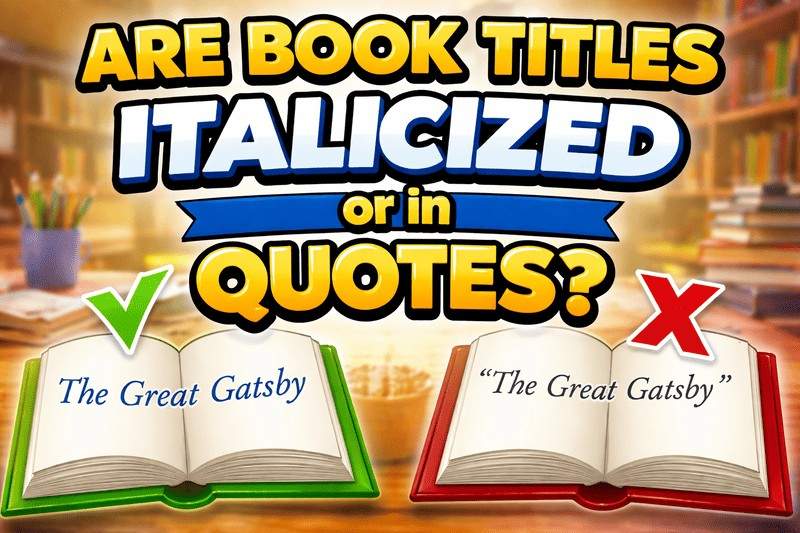
Many students and beginner writers often ask the same question when preparing essays, articles, or academic assignments: should book titles be italicized or placed inside quotation marks?
This question may seem small, but correct formatting is an important part of professional writing.

It helps readers understand what kind of source you are referring to and shows that you follow recognized academic conventions.
In standard English writing practice, the general rule is simple. Book titles are italicized, while quotation marks are used for shorter works that appear inside larger publications.

Understanding this distinction makes your writing clearer, more organized, and academically accurate.
The Basic Rule for Writing Book Titles
In most formal writing contexts, including essays, research papers, blog articles, and reports, titles of full-length books should always be written in italics.
This formatting signals to readers that the text refers to a complete, standalone publication rather than a section within a larger work.
Examples include:
- The Great Gatsby
- To Kill a Mockingbird
- Harry Potter and the Sorcerer’s Stone
- Thinking, Fast and Slow
These examples show how italics visually separate book titles from surrounding sentences.
This small formatting choice improves readability and helps readers immediately recognize references to published works.
Major academic institutions and publishers support this rule. Style systems such as the Modern Language Association, the American Psychological Association, and The Chicago Manual of Style all recommend italicizing book titles in formal writing.
Why Italics Are Used for Book Titles
Formatting in academic writing is not random. Each formatting choice has a purpose. Italics are used for book titles because books are considered long-form works that exist independently as complete publications.
When readers see italics in a sentence, they quickly understand that the writer is referring to a major source rather than a small section of text. This helps maintain clarity, especially in essays that include multiple references.
For example:
- The theme of moral responsibility is central to To Kill a Mockingbird.
Here, italics clearly signal that the sentence refers to a full-length novel rather than a chapter or article.
When Quotation Marks Should Be Used Instead
Quotation marks are not incorrect punctuation. They simply serve a different purpose.
Instead of marking complete works, quotation marks are typically used to identify shorter texts that appear inside larger works.
These shorter texts are still important, but they are considered parts of a broader publication rather than independent titles.
Examples include:
- Chapter titles
- Poems
- Short stories
- Magazine articles
- Journal articles
For instance, consider the following sentence:
- I learned about symbolism in the chapter “The Valley of Ashes” from The Great Gatsby.
In this example, the formatting helps readers understand the structure of the source.
The book title The Great Gatsby is italicized because it is a complete novel, while the chapter title “The Valley of Ashes” appears inside quotation marks because it represents only one section of the larger book.
This distinction improves precision in academic writing and prevents confusion when multiple sources are discussed together.
What Major Academic Style Guides Recommend
One reason this formatting rule is widely accepted is that it appears consistently across major academic style systems.
Although different disciplines sometimes follow different citation styles, the treatment of book titles remains largely the same.
According to the Modern Language Association, writers should italicize the titles of books, plays, and films because they are complete works
Meanwhile, shorter texts such as articles and chapters should be placed inside quotation marks.
Similarly, the American Psychological Association recommends italicizing book titles both in reference lists and when mentioning them within academic writing.
This practice ensures consistency across psychology and social science publications.
The The Chicago Manual of Style, which is widely used in publishing and humanities research, also supports italic formatting for book titles.
Because these three major style systems agree on the same rule, students can confidently apply italics in most writing situations.
Situations Where Quotation Marks May Still Appear Around Book Titles
Although italics are the standard format, there are a few situations where quotation marks may still be used around book titles.
These situations usually occur when technical formatting options are limited rather than because the rule has changed.
For example, quotation marks may appear when:
- Writing in plain text environments that do not support italics
- Sending quick notes or informal messages
- Using simple interfaces that remove formatting styles
In these cases, quotation marks function as a practical substitute rather than a preferred academic format.
However, whenever italics are available, they should always be used for book titles in formal writing.
Common Mistakes Writers Should Avoid
Because formatting rules may seem small, writers sometimes overlook them.
However, consistent formatting improves both clarity and credibility in academic work.
Paying attention to these details helps readers trust your writing and understand your references more easily.
Some common mistakes include:
- Using quotation marks instead of italics for book titles in essays
- Italicizing chapter titles instead of placing them in quotation marks
- Mixing formatting styles within the same document
- Forgetting to format titles consistently across paragraphs
Avoiding these mistakes will make your writing look more professional and organized.
Final Conclusion
Understanding whether book titles should be italicized or placed in quotation marks is an essential skill for students, researchers, and content writers. In most academic and professional contexts, the correct choice is clear.
Book titles should be italicized, while quotation marks are reserved for shorter works such as chapters and articles.
By applying this simple rule consistently, writers can improve readability, follow international writing standards, and present their ideas more effectively in both academic and online environments.